Machine learning
Published:
Gaussian Process Regression for Machine Learning on Effective Crystal Graphs of Body-Centered Cubic Iron
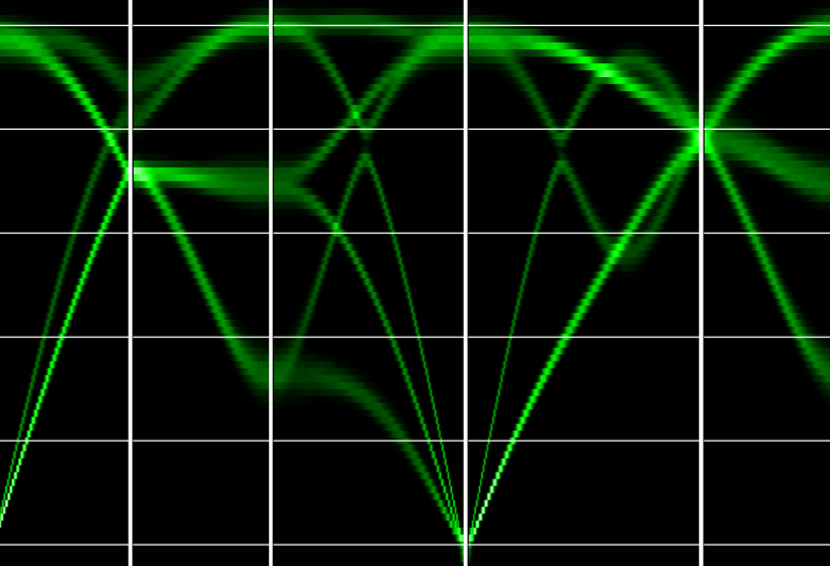
Most machine learning algorithms operate on vectorized data with Euclidean structures because of the significant mathematical advantages offered by Hilbert space, but improved representational efficiency may offset more involved learning on non-Euclidean structures. Recently, a method that integrates the marginalized graph kernel into the Gaussian process regression framework was used to learn directly on molecular graphs. Here, we describe an implementation of this method for crystalline materials based on effective crystal graph representations: the molecular graphs of 128-atom supercells of body-centered cubic (BCC) iron with periodic boundary conditions. Regressors trained on hundreds of time steps of a density functional theory molecular dynamics (DFT-MD) simulation achieved root mean square errors of less than 5 meV/atom. The mechanical stability of BCC iron was investigated at high pressure and elevated temperature using regressors trained on short DFT-MD runs, including at conditions found in the inner core of the earth. Phonon dispersions obtained from the short runs show that BCC iron is mechanically stable at 360 GPa when the temperature is above 2500 K. Atoms in the super cell were displaced in the direction of the first, second, and third nearest-neighbors from selected configurations that included thermal atomic displacements, and forces exerted on the displaced atoms were computed by numerical differentiation of the regressors.
Blaise Awola Ayirizia, Adrian De la Rocha, Valeria I. Arteaga-Muñiz, Yu-Hang Tang, Bert De Jong, and Jorge A. Muñoz San Martín. Solids 6, 62 (2025).
Entropic clustering of objects
An embodiment of a semiconductor package apparatus may include technology to map a collection of data into two or more mathematical graph representations of the data based on a configurable set of rules that one of preserves or enhances relationships or properties of the data, and organize the two or more graph representations into two or more clusters of data based on graph information entropy and one or more parameters. Other embodiments are disclosed and claimed.
J.A. Muñoz, US Patent 11,238,308 (granted February 1, 2022)
Entropic classification of objects
There is disclosed in an example a computing apparatus for assigning an entropy score to a document to be added to a corpus in a first temporal state having a first corpus entropy, having one or more logic elements, including at least one hardware logic element, providing a classification engine to: receive the document to be added to the corpus; add the document to the corpus, creating a second temporal state of the corpus; compute a second corpus entropy for the second temporal state, based at least in part on a morphism; and assign the document a gentropy score based at least in part on a difference between the first corpus entropy and the second corpus entropy.
J.A. Muñoz, US Patent 10,956,476 (granted March 3, 2021)